Sony Alpha NEX-5N
Sony Alpha NEX-5N Overview
by Dave Etchells, Mike Tomkins, Zig Weidelich, and Shawn Barnett
Hands-on Preview Posted: August 24, 2011
Full Review: December 5, 2011
Though
outwardly it looks quite similar to its predecessor, the Sony NEX-5N
has made quite a few inner changes that are worthy of note. Its
16.1-megapixel EXMOR APS-C sensor is a slight upgrade of the NEX-5's
14.2 megapixels, but the news is the sensor's new electronic
first-curtain exposure mechanism, allowing the NEX-5N to realize a
prefocus lag time of just 0.02 second (this new electronic first curtain
is also seen in the Sony NEX-7, A77 and A65, which also debuted at the
same time).
The new sensor and Bionz processor also allow capture of
Full HD video at 60p. A new touchscreen adds a few functions, but
doesn't serve to replace any existing functions. The NEX-5N is also the
first NEX -- or compact system camera for that matter -- to reach 10
frames per second at full resolution.
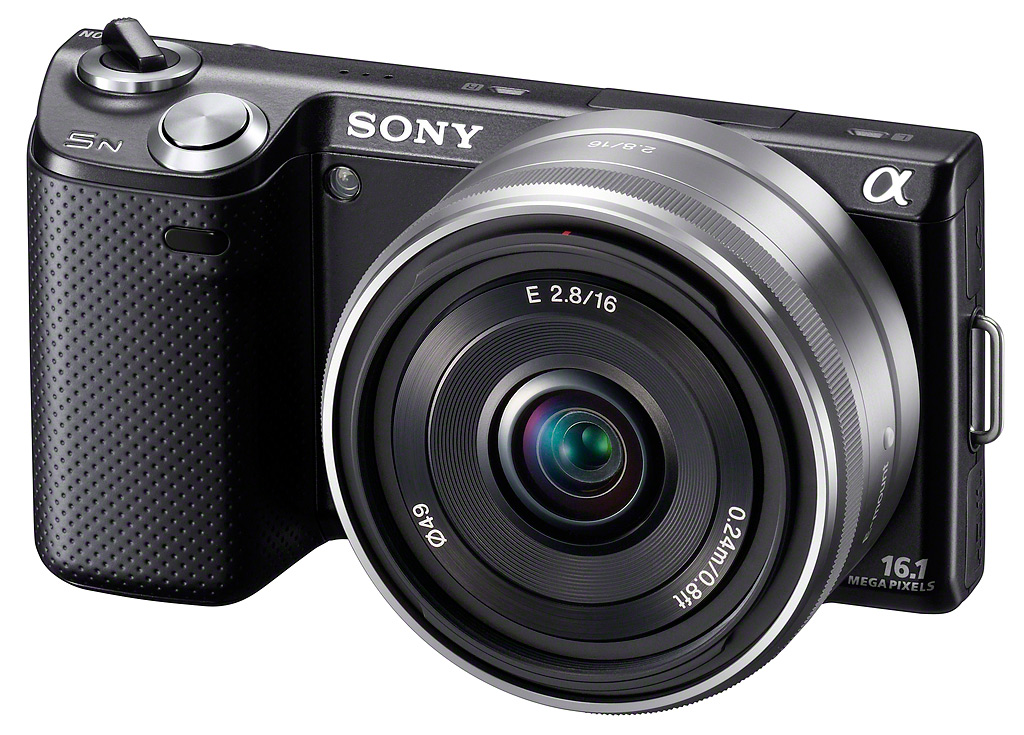
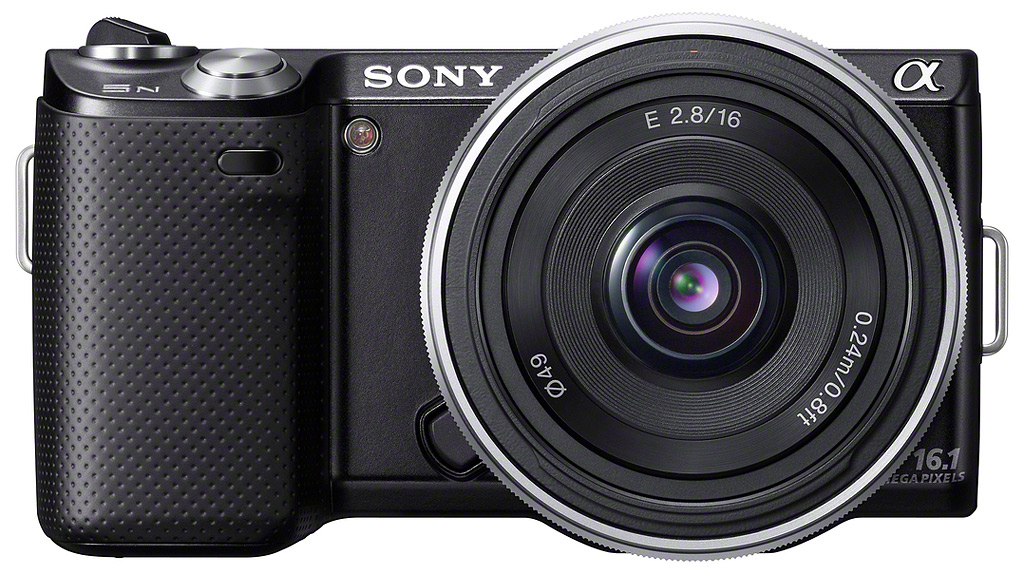
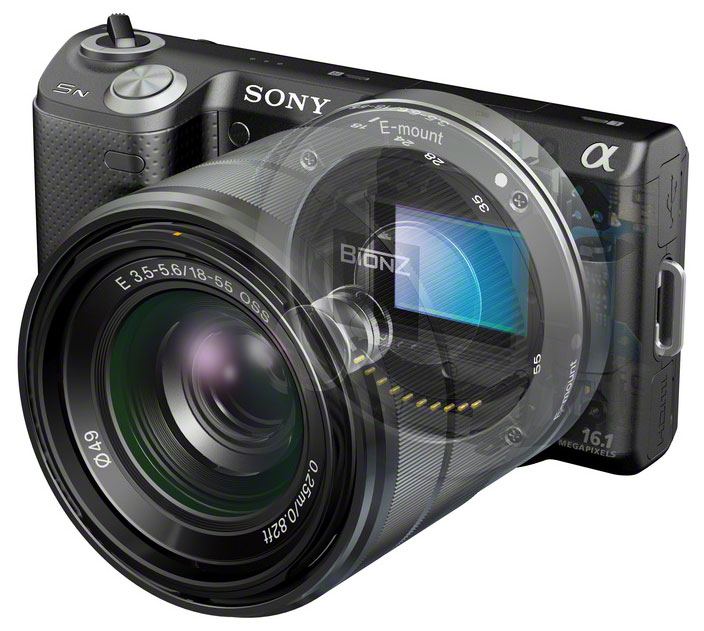
The front of the NEX-5N is also a little different, with a slight
bevel behind the lens, where the company and Alpha logos now live. "5N"
is also stamped into the front of the grip next to the shutter button.
The grip has a new broader dimple pattern in place of the raised
bump pattern. Other than those items, there's very little different on
the front. The 16mm f/2.8 lens is shown mounted here, though it's not
mounted on the image below.
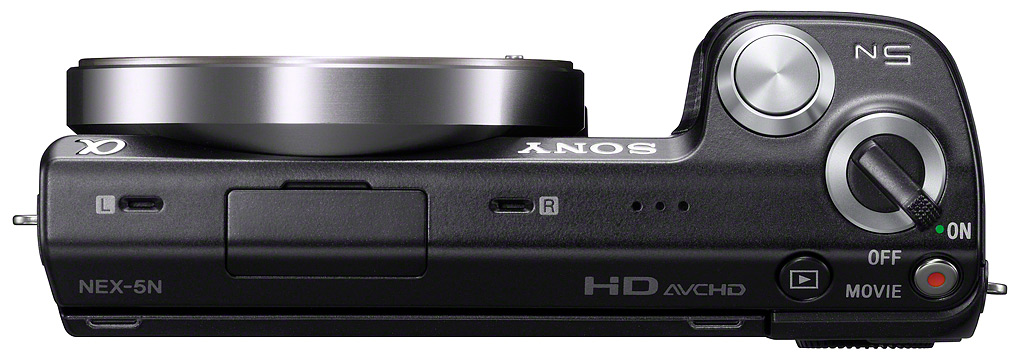
The only major difference from the top is a silver ring around the
power switch (the 5 has a black ring), and the Playback button is
smaller, round, and on the back bevel rather than the top deck. The
three speaker holes have moved over a few tenths of an inch.
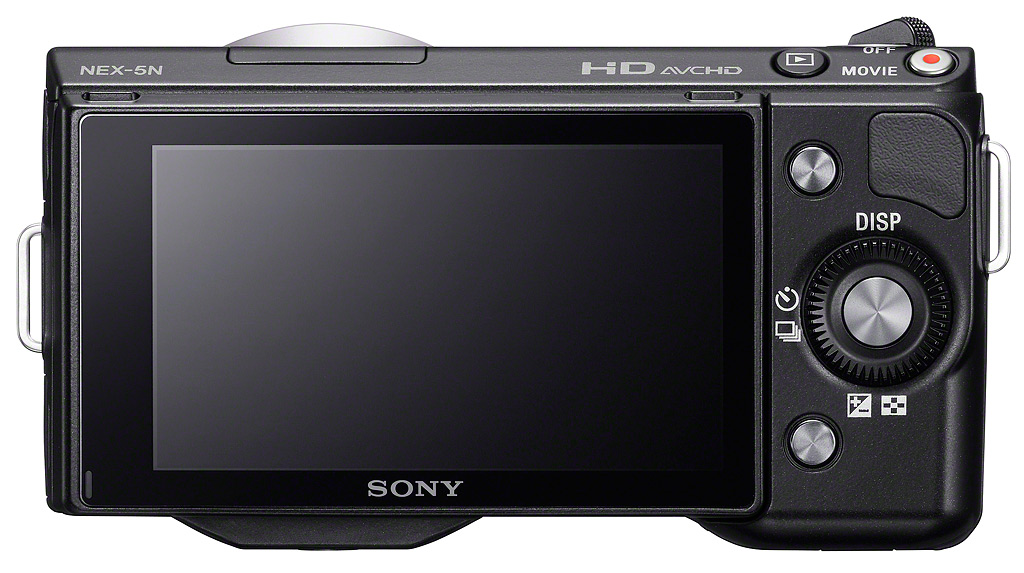
Other than the Playback button's greater visibility from the rear
and the slightly smaller Sony logo, the rear physical controls,
appearance, and function are identical to the Sony NEX-5.
Overall, it's the same sweet little camera with some very cool new tricks.
Sony NEX-5N Technical Info
by Mike Tomkins, Zig Weidelich, and Dave Etchells
Sensor and processor. The Sony NEX-5N is based
around the combination of a 16.1 megapixel Exmor APS HD CMOS image
sensor, and the company's proprietary Bionz image processing engine.
Although the resolution is very close to that of the recent NEX-C3, the
sensor is actually newly developed. Total pixel count is some 16.7
megapixels, and the sensor's dimensions are 23.5 x 15.6mm, yielding a
1.5x focal length crop when compared to 35mm lenses. The NEX-5N's sensor
has a standard RGB Bayer color filter.
With a 3:2 aspect ratio, the NEX-5N can provide maximum image
dimensions of 4,912 x 3,264 pixels at full resolution. Two further 3:2
aspect ratio resolutions are available: 3,568 x 2,368 pixels, or 2,448 x
1,624 pixels. The NEX-5N also provides a choice of three 16:9 aspect
ratio shooting modes, each of which has the same pixel width as its 3:2
aspect counterpart, but with heights of 2,760, 2,000 or 1,376 pixels
respectively.
The Sony NEX-5N offers an extremely wide sensitivity range of ISO
100 to 25,600 equivalents in one EV steps, with sensitivities between
100 and 3,200 equivalents available either under automatic or manual
control. The remainder of the range is available only when selected
manually. High ISO noise reduction cannot be disabled altogether, but
provides two adjustable operating strengths: Normal or Low.
Optics. Like all of the company's NEX-series
cameras, the NEX-5N natively accepts only Sony E-mount lenses, although
it can also accept an unusually wide range of lenses via mount adapters
provided by Sony and third parties. As with its siblings in the
NEX-series, the 5N doesn't provide in-body image stabilization, and
instead relies on optical image stabilization in the lens, if available.
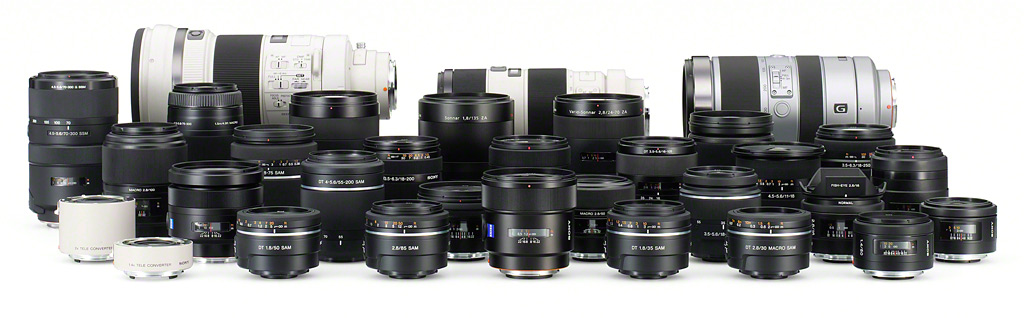
Five Sony E-mount lenses are already shipping in the US market: a
16mm f/2.8 prime, a 30mm f/3.5 macro prime, an 18-55mm f/3.5-5.6
stabilized zoom (available in a kit with the NEX-5N body), an 18-200mm
f/3.5-6.3 stabilized zoom, and a 55-210mm f/4.5-6.3 stabilized zoom. Two
further models are slated to ship imminently: a Carl Zeiss Sonnar T* E
24mm f/1.8 prime, and a Sony 50mm f/1.8 stabilized prime, both currently
scheduled to arrive in December 2011. The company's roadmap further
calls for a Sony G-branded standard zoom, a wide angle zoom, and a
mid-telephoto prime during 2012.
As well as Sony's own Alpha-mount SLR lenses (and the Minolta /
Konica-Minolta Alpha-mount lenses which predate Sony's purchase of
Konica-Minolta's SLR business), the NEX-5N can also be adapted to shoot
with Alpha, C-mount, Canon EF-, EF-S, and FD, Contax G, Contarex, Contax
/ Yashica, Exakta, Fujica X, Hasselblad Xpan, Leica M, M39, or R-mount,
M42 mount, Micro Four Thirds, Minolta A or SR-mount, Nikon F-mount,
Olympus OM or PEN F, Pentax K-mount, Rollei, or T2-mount lenses. An
impressive list indeed, although, it should be noted that each adapter
will have differing limitations, and the majority will be manual-focus
only.
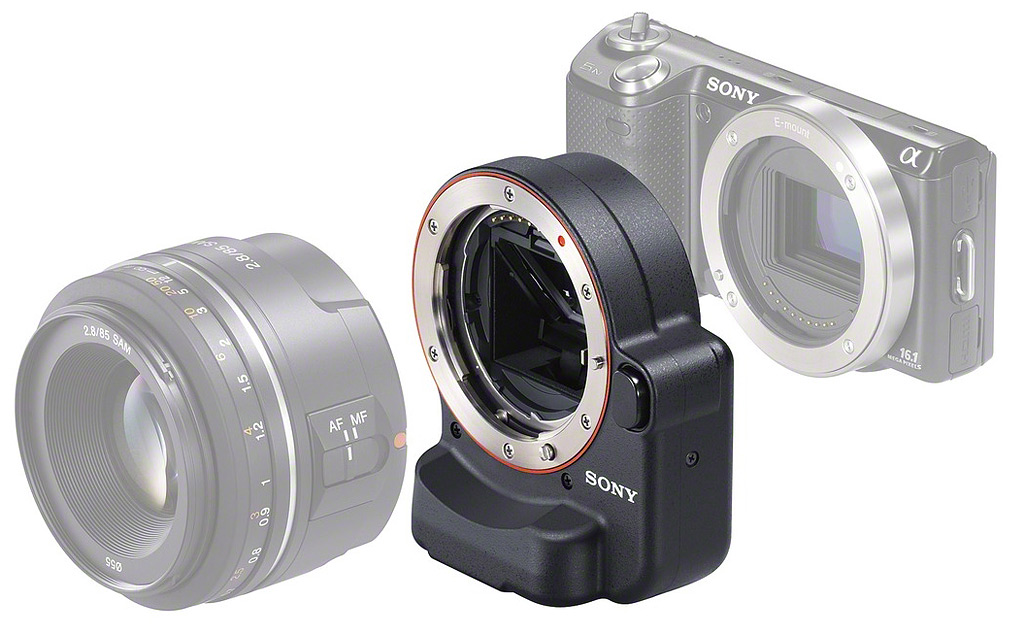
Another item announced alongside the 5N makes the NEX-series unique
among mirrorless cameras in providing support for phase detection
autofocus. The LA-EA2 adapter will provide phase detection autofocusing
with tracking, predictive control, and AF micro adjustment for all
AF-capable Alpha-mount lenses, but cannot be used with a teleconverter.
If coupled with Sony's FDA-EV1S electronic viewfinder, the LA-EA2
adapter also provides the ability to start autofocus operation the
instant that you bring your eye to the viewfinder, potentially reducing
the time taken to achieve a focus lock. Available in the US since
November 2011, the Sony LA-EA2 mount adapter is priced at around US$400.
Focusing. Of course, when you're not using the
LA-EA2 mount adapter, the Sony NEX-5N is limited to contrast detection
autofocusing, just like any other compact system camera would be. Sony's
AF system in the NEX-5N offers 25-point autofocusing, and has a working
range of EV 0-20 at ISO 100 equivalent, with an f/2.8 lens. The company
says that it has implemented a new autofocus algorithm that improves
focusing performance and speed, and indeed, we found it to be very fast
by compact system camera standards, and even competitive with many SLRs.
There are some other important differences compared to previous
NEX-series models, too. Key among these comes thanks to the NEX-5N's new
touch-panel display (more on that later): it's now possible to trigger
autofocus operation by touching your desired subject on the LCD panel.
Touch autofocus is something we've seen on a few competing compact
system cameras, where we've found it to be quite intuitive, but it's
brand-new for Sony. It's particularly handy for movie shooting, thanks
to the full-time movie autofocus.
As well as the 25-point mode, the NEX-5N's autofocus system can be
configured to operate either with a single point at the center of the
image frame, or a flexible point that can be moved around the frame
(within an 11 x 17 grid) to focus on a specific off-center subject. The
NEX-5N provides both single-servo and continuous-servo autofocus
operation. A built-in LED autofocus illuminator helps the NEX-5N to
achieve a focus lock on nearby subjects in low ambient lighting
conditions. Working range for this AF assist lamp varies depending on
the specific lens in use, but with the 18-55mm kit lens, has a working
range of 1.6 - 9.8 feet (0.5 - 3.0 m).
As you'd expect, it's also possible to focus manually with the Sony
NEX-5N, either after an autofocus operation has been performed (Direct
Manual Focus, in Sony parlance), or without any prior autofocus
operation. When focusing manually, Sony offers two Manual Focus Assist
zoom levels to aid in determining the precise point of focus, either
4.8x or 9.5x. Also included is the "focus peaking" display which was
introduced in the NEX-C3. This makes it easier to identify the point of
focus by highlighting the areas of strongest image contrast. When
enabled, three highlight colors are available (white, red, or yellow),
and the peaking function can operate at one of three sensitivity levels
(high, mid, or low.)

Lens correction. When shooting in JPEG mode, the
Sony NEX-5N includes the ability to automatically correct lens shading
(vignetting), lateral chromatic aberration, and distortion in-camera, as
images are captured. We don't currently have any information as to
which specific lens models are supported for this feature.
Performance. The NEX-5N offers significantly
improved performance over the NEX-5 in a couple of key areas. Our tests
agreed with Sony's claimed prefocused shutter release lag of just 0.02
seconds, which the company says is not only five times faster than that
of the NEX-5, but the fastest of any interchangeable lens camera.
Burst shooting is equally swift, with a maximum rate of ten frames
per second possible in the Speed Priority Continuous burst mode, which
locks focus and exposure from the first frame. Burst depth in this mode
is rated by Sony as 10 fine / standard JPEG frames, six raw frames, or
four raw+JPEG frames.
See the
Performance page to see how the Sony NEX-5N performed in the lab.
Dust reduction. As with the NEX-5 before it, the
Sony NEX-5N includes a two-pronged dust reduction strategy, with a
charge protection coating on its low-pass filter that aims to prevent
dust adhering in the first place, and the ability to vibrate the filter
to shake free any stubborn particles that manage to adhere despite the
coating. Sony describes the latter system as being new, although it
hasn't detailed precisely what changes have been made. (We do note that
it is now using the term "ultrasonic vibration" in its marketing
materials for the NEX-5N, however, and given that the dust reduction
cycle is no longer clearly audible, that suggests that it has probably
increased the vibration frequency.)
The NEX-5N's dust reduction system operates when the camera is
switched off, which helps to reduce the startup time, while not relying
entirely on the user remembering to manually trigger a dust reduction
cycle. It is, however, possible to perform a cycle manually through the
menu, if desired.

Display. On the rear panel of the Sony NEX-5N is
an articulated TFT LCD screen that, unless you have the optional
electronic viewfinder attached, is the sole method of framing and
reviewing images or movies. Like that of its predecessor, the NEX-5N's
panel can be tilted approximately 80 degrees upwards, for waist-level or
low-to-the-ground shooting, or around 45 degrees downwards for shooting
over a crowd. The panel's basic specifications are also unchanged, with
a three-inch diagonal, 16:9 aspect ratio, total resolution of 307,200
pixels (921,600 dots), and Sony's TruBlack anti-glare design. There's
also still an automatic brightness control with five-step manual
override, plus a Sunny Weather mode which increases brightness still
further for better visibility under bright ambient lighting.
As briefly mentioned earlier, there's one very significant
difference between the NEX-5N's display, and that of the NEX-5, however.
In a first for a NEX-series camera, the Sony NEX-5N includes an
electrostatic, touch-sensitive overlay that allows it to be used as an
input device. Compared to resistive touch panels, electrostatic (or
capacitive) panels have better light transmission, are more
scratch-resistant, and generally have a longer operating lifetime.
They're also less likely to react to accidental bumps, since they work
by detecting minute differences in electrical charge across the surface
of the panel when touched by a conductor such as a human finger.
The NEX-5N's touch panel not only allows the photographer to
indicate the subject on which to focus with a simple touch, but can also
be used to navigate menus, and make settings changes. In addition,
Sony's iAuto mode includes on-screen slider controls with user-friendly
names such as Brightness (exposure compensation), Color (white balance),
Vividness (saturation), Background Defocus (aperture control) and
Picture Effect. Of course, not everybody is a fan of touch-screen
interfaces, and for photographers who prefer physical controls, the
NEX-5N still provides the same user-configurable soft controls as in the
NEX-5.
As well as its built-in LCD panel, the Sony NEX-5N is compatible
with the company's optional CLM-V55 LCD panel accessory, a five-inch,
800 x 480 pixel display that attaches via the HDMI port, and includes a
detachable hood to improve daylight visibility. The CLM-V55 requires an
NP-FM500H battery pack or PW10AM AC adapter for power, as well as a
VCT-55LH bracket to attach, all of which are optional accessories.
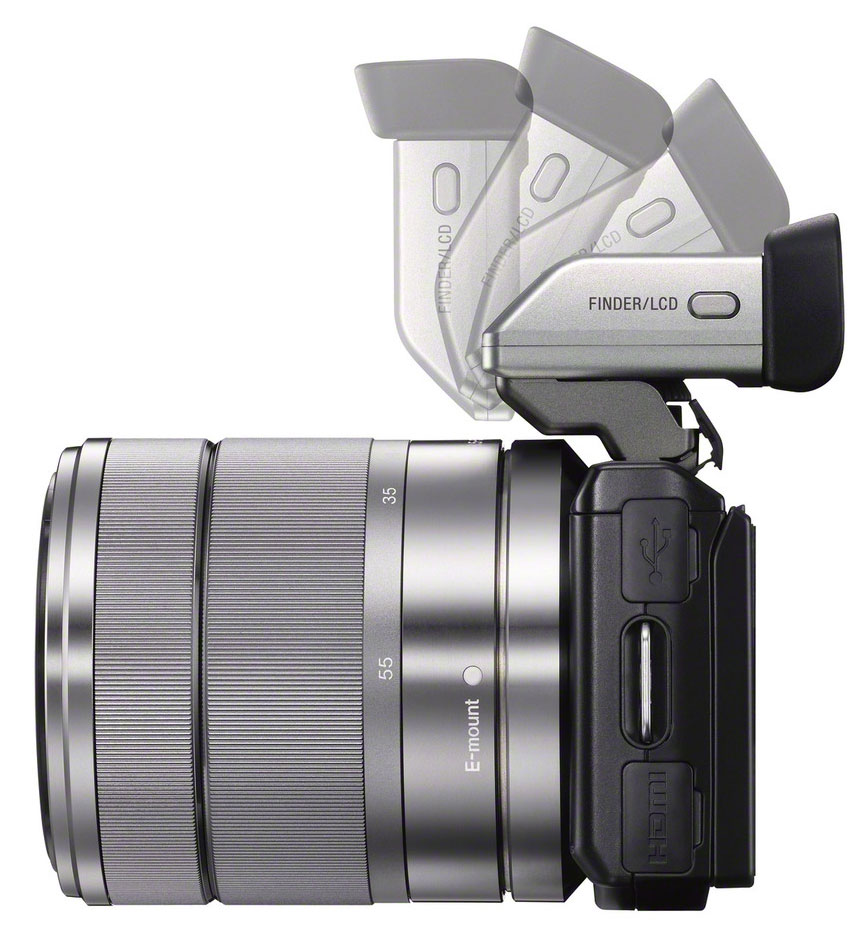
Optional Electronic Viewfinder. Alongside the
NEX-5N, Sony has announced the new FDA-EV1S XGA OLED Tru-Finder EVF.
This optional viewfinder is closely related to that used in Sony's
flagship Alpha SLT-A77 Translucent Mirror camera, although it does have a
slightly lower eyepoint. Resolution is a high 1,024 x 768 pixels (2.4
million RGB dots), and the EV1S plugs into the camera's Smart Accessory
Terminal 2 port. Note that it's not compatible with the older terminal
found on the NEX-5, NEX-3 and NEX-C3.
The variable-angle display tilts up to 90 degrees and offers full
shooting information overlay. Sensors in the eyepiece automatically
activate it when you put it you your eye, while automatically disabling
the LCD monitor to save power. There's also a Finder/LCD button for
manually switching displays. Note, though, that it's use precludes
attachment of a flash strobe, so exposures with the FDA-EV1S are of
necessity limited only to available light.
Exposure. The Sony NEX-5N offers a choice of nine
basic operating modes, unchanged from the NEX-5: Intelligent Auto
(iAuto), Programmed AE, Aperture-priority AE, Shutter-priority AE,
Manual, Sweep Panorama, 3D Sweep Panorama, Anti Motion Blur, and Scene
Selection. This last will automatically set the camera up for one of
eight common scene types, as selected by the photographer. Available
scene modes are Portrait, Landscape, Macro, Sports Action, Sunset, Night
Portrait, Night View, and Hand-held Twilight.
As in Sony's recent cameras, the Hand-held Twilight and Anti Motion
Blur modes are similar in that they capture six sequential frames with
higher sensitivity / shutter speeds to prevent blurring, and then
combine them in-camera to yield a single frame with reduced noise
levels. They differ from each other in that Hand-held Twilight mode will
generally opt for lower (but still hand-holdable) shutter speeds than
in Anti-Motion Blur mode. The Sweep Panorama modes each capture a burst
of images for as long as the shutter button is held down, then
automatically stitch them into a panorama. (The 3D mode generates a
single image with separate left-eye and right-eye views of the scene, as
the subject passes across the field of view).
As with all compact system cameras, the NEX-5N's performs exposure
metering using its image sensor. The metering system in the NEX-5N
assesses the metered scene as 1,200 separate zones, and has a working
range of EV 0 - 20 at ISO 100 equivalent, with an f/2.8 lens attached.
Available metering modes include Multi-segment, Center-weighted, and
Spot. There's not a separate Autoexposure Lock function, but the metered
exposure is locked along with focus when using multi-segment metering.
Exposure compensation is available within a range of 3.0 EV on either
side of the metered exposure, in 0.3 EV steps, and the NEX-5N can also
perform three-frame bracketed exposures with a step size of either 0.3
or 0.7 EV.
The Sony NEX-5N offers a generous selection of ten white balance
modes, including Auto, six presets (Daylight, Shade, Cloudy,
Incandescent, Fluorescent, and Flash), a direct color temperature
setting (2,500 to 9,900 Kelvin), a color filter setting (15-steps of
green to magenta bias, and 15-steps of blue to amber bias), plus a
Custom white balance mode. There's also a white balance fine adjustment
function available.
Available drive modes include Single-shot, Continuous, Speed
Priority Continuous, Self-timer (with a delay of two or ten seconds),
Continuous Self-timer (shoots three or five exposures, after a ten
second delay), Bracketing, and Remote Commander (for use with the
optional RMT-DSLR1 infrared remote control unit). The Speed Priority
Continuous mode is particularly impressive, achieving a full ten frames
per second, with exposure locked from the first frame.
Shutter speeds from 1/4,000 to 30 seconds are possible, and the
NEX-5N also offers a bulb shutter function that will hold the shutter
open for as long as the shutter button is depressed. Flash sync is at
1/160 second. An optional long-exposure noise reduction function is
available for exposures shot with shutter speeds longer than 1 second.
The NEX-5N focal-plane shutter has the same exposure specs as for
the earlier NEX-5, but the NEX-5N has obviously been goosed up some to
get its amazing 10 frames per second at full 16-megapixel resolution.
The most noticeable change in the NEX-5's exposure system is its use of
an "electronic first curtain." This improves performance while reducing
noise and vibration, and overall is a very welcome addition.
Sony NEX-5 Electronic First Curtain: Fast and quiet. A
key technology in all Sony's August 2011 Alpha and NEX announcements is
the "electronic first curtain" exposure capability. This greatly speeds
the shutter release on live-view cameras, and significantly reduces
shutter-generated vibration as well. A little explanation is perhaps in
order.
In a conventional SLR, the focal-plane shutter is composed of two
leaves or "curtains" that work together to control the exposure time.
Think of your camera's sensor as a window with two windowshades; one
rolling up from the bottom, the other rolling down from the top. The
first curtain starts the exposure by dropping down to uncover the
sensor. The second curtain ends the exposure by dropping down to cover
it again. After each exposure, the shutter curtains are returned to
their original positions in preparation for the next shot. Very short
exposures are made by having the two curtains move together, moving a
small slit across the focal plane.
To help you visualize, here are a couple of animations showing the action described above, one for a
longer exposure, the other for a
short one;
once the graphic loads, click the button to see the shutter animation.
(These animations are from Photocourse.com; check out their excellent
Textbook of Digital Photography.)
In a live-view camera, the shutter curtains are initially open, so
light can reach the sensor to create the live viewfinder display. In
live view mode with a conventional mechanical shutter, the bottom
curtain has to be raised first, before the exposure can begin. This of
course takes time, increasing the shutter lag before the exposure can
begin. The closing of the first curtain can also introduce additional
vibration, affecting image sharpness at some shutter speeds. (See our
detailed discussion of the
blur anomaly in the original Olympus E-P1
for an example. The same issue exists to a greater or lesser degree in
most mirrorless cameras, though it's all but invisible in some.)
What's new in this latest crop of Sony cameras is that the "first
curtain" function is performed electronically. Rather than having to
raise the shutter curtain before the exposure, the NEX-5N, NEX-7, A65,
and A77 all begin the exposure electronically, manipulating voltage
levels on the sensor array to enable light-gathering in a progressive
wave, sweeping down the sensor's surface.
The most noticeable result of this is that shutter lag in live view mode is very brief: Sony claims only 20 milliseconds
(0.02 second), a number closely matching the 22 milliseconds we
measured electro-optically in our lab. The reduced curtain movement also
reduces shutter-induced camera vibration, and makes for a much quieter
shutter release as well: All Sony's new cameras with this shutter setup
are unusually quiet in operation.
This isn't the first time we've seen an electronic first-curtain: The
Canon 40D SLR introduced the concept back in August of 2007, and as far
as we know, Canon live-view-capable SLRs still employ the technology.
There's a significant difference in what we call prefocused release lag,
though, with Canon's SLRs in Live View mode measuring in the range of
80-90ms, vs the astonishing 20ms for the NEX-5N and NEX-7. A 20ms
release time is actually quite a bit faster than even very high-end
professional SLRs can manage. (The Nikon D3s is one of the very fastest,
with a release lag of 43ms, measured on the same test equipment we used
for the NEX-5N.)
Face detection. Even among SLRs, face detection
during live view is a fairly common feature these days, and for compact
system cameras its pretty much standard. The Sony NEX-5N does a step
further, though, in offering the ability to register the faces of eight
specific individuals, who will then be automatically recognized and
prioritized over other faces when determining focus, exposure, and flash
output, as well as during post-exposure image processing. The NEX-5N is
capable of simultaneously detecting and accounting for up to eight
faces in any given scene, and also includes a Smile Shutter function
with three-step sensitivity, which will automatically capture an image
when your subject is smiling. Of course, face detection can be disabled,
should you wish.
In addition, Sony is using its face detection capability to allow
the user to further process images after capture. A Soft Skin Effect
function can be used to locate faces in an image, and then smooth out
the skin tone areas to reduce or remove fine wrinkles, freckles, and the
like. Three retouching levels are available--low, mid, or high--and
like the pre-capture face detection function, this tool can identify up
to eight faces in a scene.

Flash. The Sony NEX-5N doesn't feature a built-in
flash strobe, and nor does it include a hot shoe. Thanks to its Smart
Accessory Terminal 2, which is backwards-compatible with the Smart
Accessory Terminal found on earlier NEX-series cameras, it can however,
accept proprietary external strobes. A Sony HVL-F7S flash strobe comes
bundled with the NEX-5N, and is the same model offered with the earlier
NEX-5. When not in use, it folds down flush against the top surface of
the camera body, providing the smallest possible footprint, and it's
enabled simply by raising it to stand proud about an inch over the
camera's top deck. With a guide number of seven meters (23 feet) at ISO
100, it's reasonably powerful given its size, and since it draws power
from the camera body, you needn't carry an extra battery type with you.
Recycle time is manufacturer-specified at around four seconds. Although
it is rated for 16mm coverage, we found it to yield rather uneven
illumination at wide angle even with the NEX-5N's 18-55mm kit lens. With
some lenses, vignetting is also likely to prove an issue, given the
relatively modest height of the strobe when raised.

With that said, these shortcomings can be forgiven, when one
considers its compact size and weight, as well as the fact that the
NEX-5N is also compatible with Sony's larger and much more powerful
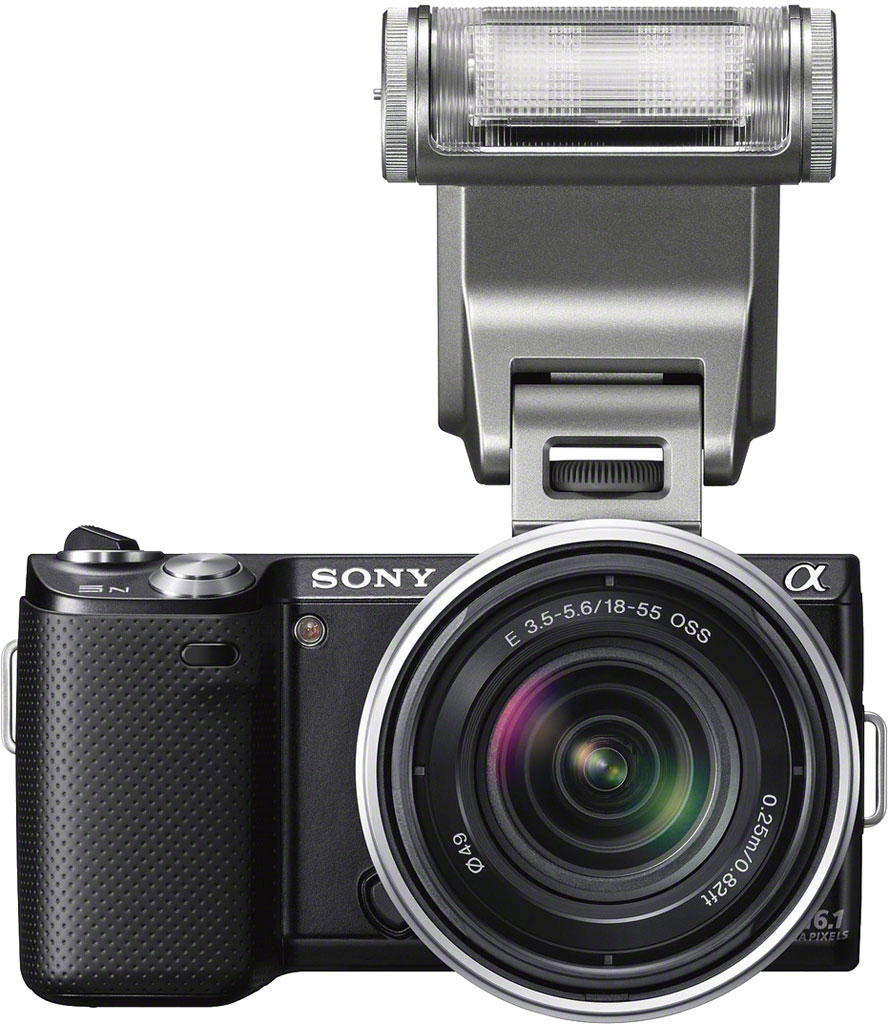
HVL-F20S flash strobe. Announced alongside the NEX-C3 back in June, and
available since August 2011, the HVL-F20S adds not only a 75-degree
bounce head, but also a selection of tele (50mm equivalent) or standard
(24mm equivalent) coverage, plus a built-in diffuser for 18mm wide angle
coverage. It has a guide number of twenty meters (66 feet) at ISO 100
using a 50mm-equivalent lens. Recycle time for the HVL-F20S is
manufactured-rated at five seconds or less. Like its smaller sibling,
the HVL-F20S draws power from the camera itself, and so doesn't need
separate batteries.
The NEX-5N uses pre-flash TTL metering, and offers +/- 2.0 EV of
flash exposure compensation, in 0.3 EV steps. Available flash modes
include Flash Off, Auto Flash, Fill Flash, Slow Sync, and Rear Sync, and
an optional red-eye reduction function is available.
Creative. The Sony NEX-5N includes quite a range
of creative controls to help photographers get the look they're after,
with a minimum of time spent in the digital darkroom. A selection of
eleven Picture Effect modes are available, five of them new since the
NEX-5 (with one mode having been removed.) The new modes include Soft
High-key (which replaces the NEX-5's High-key mode), plus Soft Focus,
HDR Painting, Rich-tone Monochrome, and Miniature. The Posterization
(color or black & white), Pop Color, Retro Photo, Partial Color
(red, green, blue , or yellow), High Contrast Mono, and Toy Camera are
all held over from the earlier camera.
In addition, the NEX-5N provides the same Creative Style choices as
in the NEX-5, each of which offers +/- three-step control over
contrast, saturation, and sharpness. Creative Style modes include
Standard, Vivid, Portrait, Landscape, Sunset, and Black & White.
A Dynamic Range Optimizer function aims to open up the shadows
while maintaining highlight detail, and can be left under automatic
control, or set to one of five preset levels. There are also several
multi-shot modes, including Hand-held Twilight and Anti Motion Blur
(both of which allows faster shutter speeds with reduced image noise),
and an Auto HDR mode. This last creates a single high dynamic range
image from three sequential shots, whose exposure level varies anywhere
from 1 - 6 EV in 1 EV steps, controlled automatically or manually.
The NEX-5N also offers an in-camera Sweep Panorama function, which
captures and stitches together multiple images as you sweep your lens
across a panoramic scene. When set to Wide mode, Sweep Panorama can
create a horizontal scene with a resolution of 12,416 x 1,856 pixels, or
a vertical scene with a resolution of 2,160 x 5,536 pixels. In standard
mode, the horizontal dimensions are 8,192 x 1,856 pixels, while
vertical panoramas occupy 2,160 x 3,872 pixels.
3D Imaging. In addition to the standard Sweep
Panorama function, the NEX-5N includes a 3D Sweep Panorama mode, which
was added to the earlier NEX-5 model via a post-launch firmware update.
Since the NEX-5N only has one objective lens, the stereo effect is
created using some clever mathematics to reconstruct a 3D image as the
subject passes across the lens' field of view. The result is saved as a
single multi-picture object file that contains two separate JPEG images,
one for each eye, allowing it to be viewed on 3D-capable Sony Bravia
displays In Wide mode, 3D Sweep Panoramas occupy 7,152 x 1,080 pixels,
while in Standard mode the resolution is 4,912 x 1,080 pixels. There's
also a 16:9 mode, which saves a 1,920 x 1,080 pixel panorama suitable
for full-screen HDTV viewing.

Video. The Sony NEX-5N also offers Full HD (1,920 x
1,080 pixel) video capture capabilities, and according to Sony, is the
world's first interchangeable-lens camera (along with other Sony models
simultaneously announced) able to record Full HD off the sensor at 60
frames per second. (We've seen cameras previously which recorded 60
interlaced fields per second at Full HD resolution, but these either
clocked the data off the sensor at 30 frames per second and then split
each frame across two interlaced fields, or they clocked the data at 60
frames per second but discarded alternating fields, to be compliant with
the original AVCHD 1080 60i specification.)
The NEX-5N's Full HD video is recorded using AVCHD Version 2.0
compression, with Dolby Digital (AC-3) audio, and a wide range of
progressive-scan and interlaced frame rates are available. When set to
NTSC mode, the available progressive-scan rate are 60 fps (28Mbps) or 24
fps (24 Mbps or 17 Mbps), and you can also opt for an interlaced 60 fps
(24 Mbps or 17 Mbps). If you switch to PAL mode, the options are the
same, except that the 60 fps rates are replaced by 50 fps equivalents,
and the 24 fps rates by 25 fps ones.
It's also possible to record at a high-def resolution of 1,440 x
1,080 pixels (12 Mbps), or a standard-definition VGA (640 x 480 pixel,
3Mbps) resolution. These are all available at 30 fps in NTSC mode, or 25
fps in PAL mode, and are captured using MPEG-4 AVC (H.264) compression
with MPEG-4 AAC-LC audio. Note that no 720p recording mode is available
on the NEX-5N.
Unlike many competing cameras, the Sony NEX-5N provides full
control over movie exposure, with a choice of Program,
Aperture-priority, Shutter-priority, or fully Manual recording. It also
allows Tracking autofocus, as well as use of Creative Style and Photo
Creativity effects during movie capture. Recording is started and
stopped with a dedicated Movie button on the NEX-5N's top panel, and
audio is captured by default with a built-in stereo microphone. As an
alternative, Sony's ECM-SST1 external microphone accessory mounts on the
Smart Accessory Terminal 2, and can provide directional audio coverage
at either 90° or 120°. A built-in monaural speaker caters to movie
playback, and has an eight-step adjustable volume setting.
Playback. To let you immediately judge
composition, exposure, and the like, the Sony NEX-5N provides an
optional Auto Review function that can display images on-screen for two,
five, or ten seconds immediately post capture. After capture, Playback
mode lets you review single images, with optional shooting information,
RGB histogram, or blinking highlight/shadow warning. In addition, images
can be enlarged up to 14x to confirm fine details. Two index views are
available, showing either six or twelve frames at once.

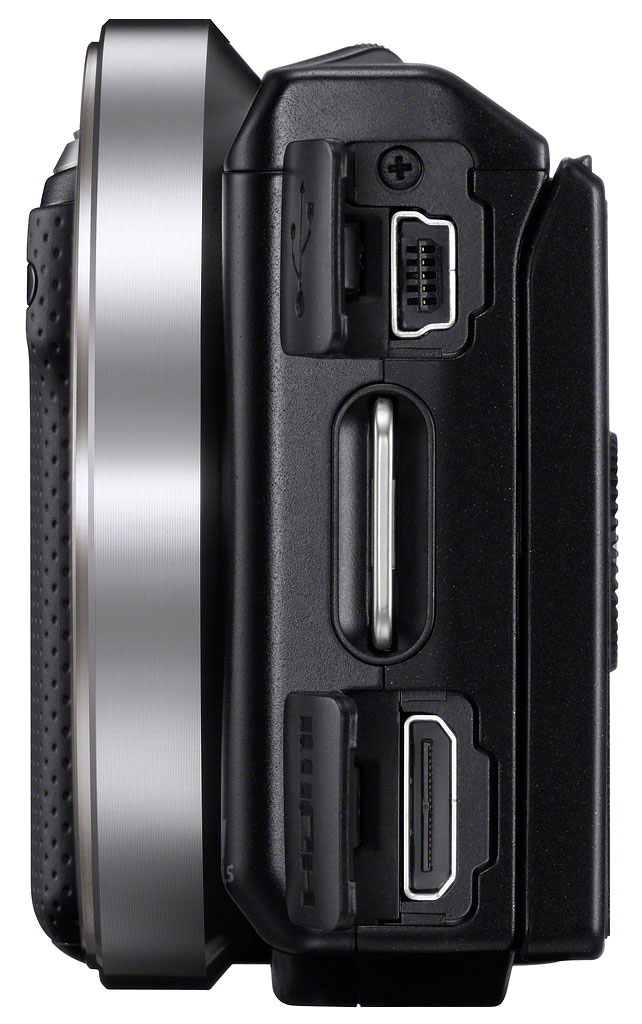
Connectivity. The Sony NEX-5N includes a USB 2.0
High Speed data connection, allowing for transfer of images and movies
to a personal computer. Two operating modes are available for the USB
connection, either USB Mass Storage Class, or Microsoft's Media Transfer
Protocol. Catering for high-definition video output, the NEX-5N also
provides a Type-C Mini HDMI connection, with support for Bravia Sync,
Sony's brandname for the Consumer Electronics Control standard. This
allows certain playback functions such as switching between images to be
performed using the attached display's remote control unit. There's no
standard-definition video output on the NEX-5N, though, so photographers
who've yet to switch to a high-def display will need a third-party
device with which to view images on a standard TV.
Although the NEX-5N doesn't have a dedicated power input, it can
accept external power via the AC-PW20 AC adaptor kit. This includes a
dummy battery which feeds power to the camera from the AC adaptor, with a
small flap in the battery compartment door providing ingress for the
dummy battery cable. With the exception of the aforementioned Smart
Accessory Terminal 2, there is no other connectivity on the NEX-5N.
Storage. As well as Sony's proprietary Memory
Stick PRO Duo and Memory Stick PRO-HG Duo flash cards, the NEX-5N can
also write images and movies to Secure Digital cards, including the
higher-capacity SDHC and SDXC types. The NEX-5N also support's Eye-Fi's
WiFi-capable SD cards, for wireless image transfer direct from the
camera body. 2D images can be saved either in Sony ARW 2.2 raw format,
or as standard JPEG files (DCF Ver. 2.0, Exif Ver. 2.3, MPF Baseline
compliant). 3D images are saved as Multi Picture Object files (MPF
Extended compliant).
Battery. The Sony NEX-5N draws power from a
proprietary NP-FW50 lithium-ion battery pack, which is rated by Sony for
430 shots to CIPA testing standards, an improvement of 30% over the
battery life of the previous NEX-5 model.
Sony NEX-5N Shooter's Report
by Shawn Barnett
Heading out with the Sony NEX-5 is a lot like taking your grip, LCD,
and a small lens out for a walk on the town, leaving the rest of your
bulky SLR at home. I love my bulky SLRs, don't get me wrong, often for
their very heft, but sometimes it's nice to have all the sensor and
optical capability with a little less weight and volume, especially when
photography will not be my primary activity.

EVF. I shot both with and without the new FDA-EV1S
electronic viewfinder, and again found myself using the LCD more often
than the EVF, especially out in the daylight (I say again because I did
the same with the new Sony A77 and A65, which have viewfinders based
around the same OLED panel). My reasons are similar, but not entirely
weighted the same. I still found the EVF more difficult to use in bright
sunlight, but the main reason I'd have preferred to leave it off is
that I like the NEX-5N without anything on the top. The EVF just kept
flipping around too much, got in the way as I held it, and sometimes
snagged against my shirt. I even had the rubbery eyecup fly off once, as
it's a little too easy to remove. I did like the way it tilted up so I
could look down into it while shooting from a very low angle, but I
could do the same with the NEX-5N's LCD, so it wasn't as big a plus as
the same feature is on a camera like the Olympus E-P3, whose LCD screen
doesn't articulate.
My other concern with the electronic viewfinder was its contrast
ratio, which was quite high. Darks looked too dark, and the viewfinder
itself was dark out in the bright light. I found the LCD worked great in
bright sunlight. On the plus side, the screen is very smooth and high
resolution, and works pretty well indoors. I could see using it for
indoor work and shooting in close quarters, but out in bright sunlight,
I'd rather have the little flip up flash attached, or else nothing at
all. If you're already used to the limitations of EVFs in bright
sunlight, I doubt you'll be too concerned with the issues I raise.


Wide and tele. Ranging from 27-82mm, the Sony NEX-5N's standard kit lens covers normal shooting conditions reasonably well.
Out shooting snaps of the family, I was grateful for the Program
shift in Program mode, as I don't like to think about aperture changes
all the time while shooting casual family shots, but when I want to
tighten up the depth of field, or even increase it, it's nice to know
it's just a turn of the rear dial to greater control. The two sliding
scales on the back tell me what's shifted in which direction, and I can
quickly get the shot I want. On a camera without two control dials, it's
a great way to shoot. The same scale appears in Aperture priority, of
necessity, since there's no physical aperture ring to look at. The
onscreen scale is better than just a number, because at a glance you get
a reminder of what the mounted lens can do, especially important for an
interchangeable lens camera. The scale also changes as you zoom with a
variable aperture lens. Good stuff. This scale is only available on one
of the four display screens, but it's the one I prefer, because it gives
you the most important information about your shooting conditions and
the camera's capability.

I liked the sure grip of the Sony NEX-5N. It's just deep and thick
enough so I can shoot vertically or horizontally one-handed. I put a
wrist strap on it, though, to keep from dropping it. Of course, I can't
zoom when shooting that way, and its not very stable, so I don't really
recommend it.
The tilting LCD is handy for horizontal shots, and I almost always
flip it up, as I don't do much shooting over crowds. I shoot more shots
of people shorter than I, so it makes sense. It's not really useful for
my more common vertical shots, also often taken from a low angle, but
the display works well enough that I can usually compose well even in
sunlight.
Like the other new Sony Alphas, the NEX-5N uses an electronic first
curtain, making each exposure quieter. The camera doesn't need to close
the first shutter curtain before opening it again to make the exposure,
making less noise, and saving time after you press the shutter. The
camera can go straight from Live View mode to capture mode, which makes
it more likely that you'll get the shot you saw before you pressed the
shutter. It's a very good thing, and is less likely to alert your
subject that you're taking their picture. Instead of a clack-clack, you
get the single clack of the second shutter curtain closing and opening
again, apparently so fast that it only makes one sound.
Menus. I still find the menus a little frustrating. I
prefer the tabbed menu system in the Alpha SLRs, as I tend to get lost
in long, endless menus. It's especially troubling when I'm searching for
a menu item whose name I can't remember.
I'd be happier if Sony revamped a few aspects of the menus. I can't
understand why they split it up the way they did. For example, I would
expect to find the ISO setting under the Camera menu, just right of the
Mode dial, but it's under Brightness/Color. I understand that on some
level, but "Exposure" would make more sense to me. Also, their practice
of graying out certain menu items, like the Panorama resolution size,
when you're not in the Panorama mode makes little sense. What if I'm
going out to shoot a variety of shots and want to make sure the camera's
Panorama mode is in vertical sweep mode, but with the Wide setting? Why
must I first enter Panorama mode to make this change?
As usual, we recommend sitting down with a cup of coffee and the
manual on a camera like this. Its few external controls can make it seem
simpler than it is -- until you dive into the menus, of course -- and
you'll miss out on some of the great functionality.
Touchscreen. You can use the touchscreen to navigate
the menus and make selections, or else just use the physical controls.
You can swipe vertically to move within the menu lists, and swipe left
and right to scroll through pictures in Playback mode. Tapping on the
screen also activates Focus Tracking mode, a nice feature, but not one I
find myself using much.
Sweep Panorama. One of Sony's best innovations in
recent memory is Sweep Panorama, and you can produce some very large,
detailed images with the Sony NEX-5N. The camera also offers a 3D Sweep
Panorama mode, which we didn't test, though we have tested the mode on
past models.
This shot, made in Wide mode, shows a 180-degree panorama that measures 12,416 x 1,856.

Full HD movie. Sample 1,920 x 1,080 60fps movie of a passing train, 87MB MTS file.
Video. Manual mode in video on a video-capable
digital camera a rarity. But not with the NEX-5N. You can select from
PASM. In fact, there's no dedicated Movie mode that you need to set to
enable video. Just press the red button on the top deck. While
recording, you can adjust both aperture and shutter speed (you have to
press the EV compensation button, the down arrow, to switch to aperture,
as shutter is the first available setting), and you can even change the
ISO while shooting. You'll have to accept the clicks and dial sounds
entering your recording, though.
Image stabilization is quite good while recording video. My train
video looks a lot more stable than I expected. Beware that there's a
loud train horn in there that will get quite a bit of attention if you
don't turn the volume down.

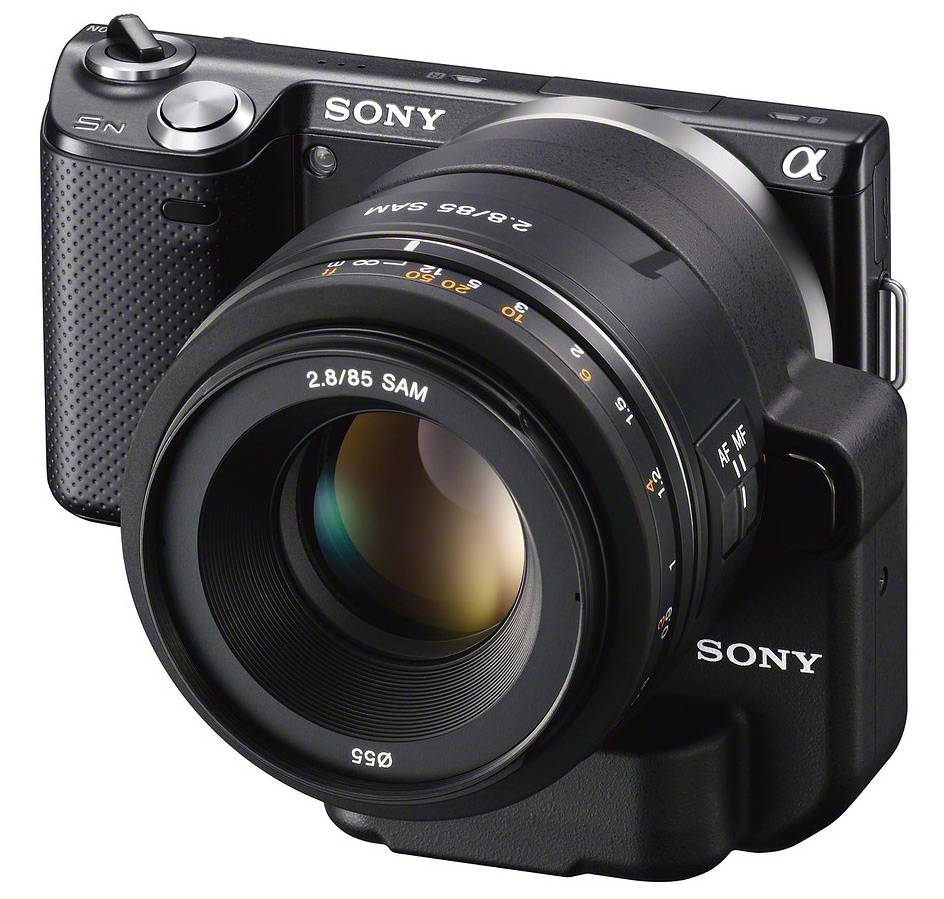
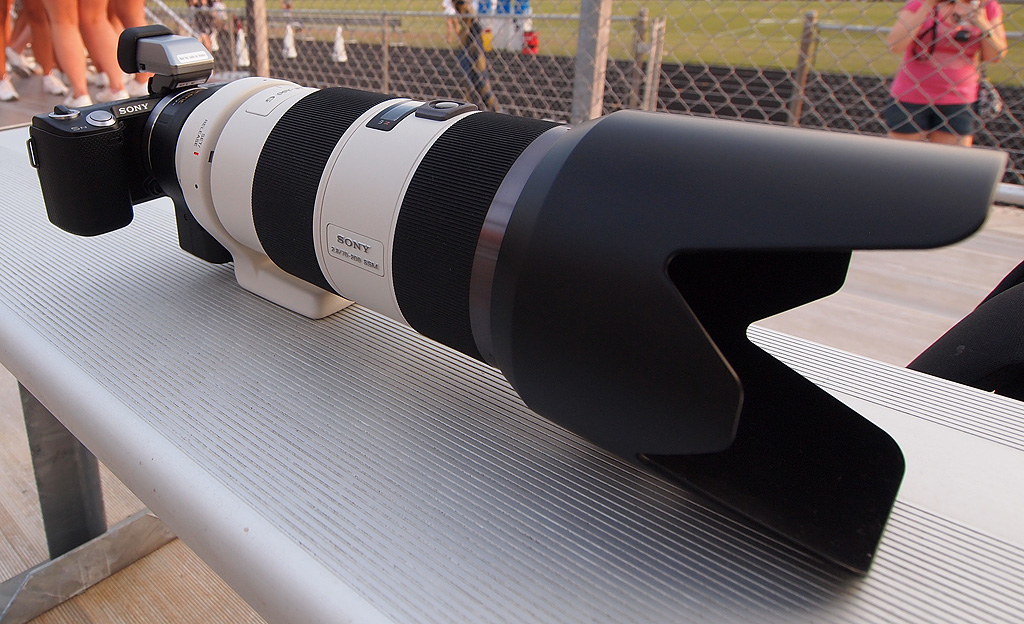
70-200mm G. Mounting the 70-200mm G lens via the LA-EA2 enables phase-detect autofocus. It's a surprisingly solid package.
Phase-detect. I decided to take the LA-EA2 out for a
spin with the new 16-50mm f/2.8, and I even tried it at a high school
football game with the Sony 70-200mm f/2.8 G lens. The combination is
large, to be sure, but I found that with the smaller lens, cradling the
LA-EA2 simulated the base of an SLR quite well, and the NEX-5N's small
but deep grip was still sufficient to control the camera. It was another
story with the larger 70-200mm f/2.8 G lens, which looked quite comical
on the very small Sony NEX-5N.
Once I got the hang of it, shooting rapid-fire with the Sony NEX-5N,
the A-mount adapter, and the electronic viewfinder (FDA-EV1S) attached
was quite similar to shooting with the A77. The shutter sound was a
little different, though, making me wonder if the electronic first
curtain is still enabled with the phase-detect autofocus system enabled.
My results, though, were disappointing. Most of my shots were either
out of focus or back-focused. The buffer didn't capture as many shots as
I was used to from the A77, either. As I tried to capture a kicker
trying for a field goal, the buffer ran out just after his windup, right
before his foot swung for the ball.

Continuous. Even this relatively flat
scene found the combo back-focusing, with the ref in the background in
better focus than the subjects. I think the camera may have paused here,
given the gap at the moment of the kick.
The crowd of sideliners were particularly good at moving in my way as
soon as the action started, so that reduced my opportunities; but what
really cramped my shooting was the battery: It died just before the end
of the second quarter. It's not really a surprise, of course, as the
little battery was hard at work running not only the camera, but also
the A-mount adapter with all its electronics, which were driving the
lens focus motor as well.
At that point, the battery was down to 49 percent, but when I removed
the lens and adapter, I was still able to shoot with the standard
E-Mount lens, shooting a few more videos and stills, but football action
was out for the rest of the evening. It's not a fair situation to test
the NEX-5N, not entirely. True, they do make the adapter, and it lets
you use these big lenses, but it's not the camera's main intent. I'm not
sure I'd recommend using the NEX-5N combined with the LA-EA2 for sports
shooting, as its fastest continuous mode doesn't support tracking
autofocus, but though the unit said "FINAL" on its sticker, it's
possible that the accessory isn't quite up to snuff as of review time.
Of course, you can shoot sports like we used to before motor drives, one
shot at a time, but it's less than ideal. The NEX-5N still has what it
takes for well-lit sporting events with the proper lens, preferably an
E-mount optic sized for the body, just make sure your subject isn't
moving toward the camera.
The Sony NEX-5N is more intended as an everywhere camera for the average shooter, and it meets those needs quite well.
Sony NEX-5N Image Quality
Most CSCs will produce very good results at base ISO, so we like to
push them and see what they can do at ISO 1,600. Recent advances in
sensor technology have made ISO 1,600 look a lot more like ISO 100, but
there are still cameras whose quality starts to fall apart at this
setting. I also choose 1,600 because I like to be able to shoot at least
at this level when indoors and at night.
Sony NEX-5N versus Olympus E-P3 at ISO 1,600
Sony NEX-5N versus Panasonic GF3 at ISO 1,600
Sony NEX-5N versus Panasonic G3 at ISO 1,600
Sony NEX-5N versus Samsung NX100 at ISO 1,600
Sony NEX-5N versus Sony NEX-C3 at ISO 1,600
Today's ISO 3,200 is yesterday's ISO 1,600 (well, almost), so below are the same crops at ISO 3,200.
Sony NEX-5N versus Olympus E-P3 at ISO 3,200
Sony NEX-5N versus Panasonic GF3 at ISO 3,200
Sony NEX-5N versus Panasonic G3 at ISO 3,200
Sony NEX-5N versus Samsung NX100 at ISO 3,200
Sony NEX-5N versus Sony NEX-C3 at ISO 3,200
Detail: Sony NEX-5N versus Olympus E-P3, Panasonic GF3, Panasonic G3, Samsung NX100, and Sony NEX-C3
 |
 |
 |
 |
 |
 |
 |
 |
 |
 |
 |
 |
 |
 |
 |
 |
 |
 |
|
Sony
NEX-5N
ISO 100
ISO 3,200
ISO 6,400
|
Olympus
E-P3
ISO 200
ISO 3,200
ISO 6,400
|
Panasonic
GF3
ISO 160
ISO 3,200
ISO 6,400
|
Panasonic
G3
ISO 160
ISO 3,200
ISO 6,400
|
Samsung
NX100
ISO 100
ISO 3,200
ISO 6,400
|
Sony
NEX-C3
ISO 200
ISO 3,200
ISO 6,400
|
|
Detail comparison. High-contrast details are often sharper
as ISO rises, so they're worth a look as well. And the Panasonic G3
rolls into the winner's column to illustrate why we also do these crops,
as it renders the lines between the letters just a little more crisply
than the Sony NEX-5N. Of course, there's a difference in image size,
thanks to the different aspect ratio, so the G3 was given an unfair
advantage. After that, the NEX-C3 comes in closest. The GF3 and NX100
fare worse.
|
Sony NEX-5N Print Quality
 Excellent
printed image quality, with ISO 100-1,600 producing good quality
20x30-inch prints; ISO 6,400 shots look good at 13x19, and even 25,600
prints make a usable 5x7.
Excellent
printed image quality, with ISO 100-1,600 producing good quality
20x30-inch prints; ISO 6,400 shots look good at 13x19, and even 25,600
prints make a usable 5x7.
The Sony NEX-5N's images are impressive over a large range of ISO
settings. ISO 100 images make excellent 20x30-inch prints, with
excellent detail and color.
ISO 200 images also look great at 20x30 inches, looking essentially identical.
ISO 400 images are almost the same as 200, but with some softening
beginning in strong, low-contrast red areas. Other detail, though, is
very crisp.
ISO 800 images still look good at 20x30 inches, only red areas continue to soften. We'd still call it acceptable.
Even ISO 1,600 shots are good at 20x30 inches, again with softening
in red areas, and some cloudy noise appearing in the shadows, but
they're still good.
ISO 3,200 images finally turn the corner, appearing just a little
too soft at 20x30 in low-contrast areas, but look better with a
reduction to 16x20 inches. Fine detail is still decent at 20x30, but the
overall image looks better one size smaller.
ISO 6,400 shots are usable at 16x20, but really look better at 13x19, which is still a pretty large print size.
ISO 12,800 images have just enough fine detail to print at 11x14,
but noise suppression in low-contrast areas merits reduction to 8x10,
which brings all but the low-contrast reds under control.
ISO 25,600 shots are a little rough at 8x10, but look decent at 5x7, though many colors are a little darker than normal.
Overall, the Sony NEX-5N's images print well, supporting 20x30-inch prints from ISO 100 to 1,600!
In the Box
The Sony NEX-5N ships with the following items in the box:
- Sony NEX-5N body
- E 18-55mm F3.5-5.6 OSS lens zoom lens (in kit version; other kits may be available outside the US market)
- Body cap
- Front and rear caps for lens
- NP-FW50 rechargeable lithium-ion battery
pack
- BC-VW1 battery charger (separate power cord
included in some markets)
- USB cable
- Shoulder strap
- HVL-F7S proprietary flash strobe and hard case
- Application Software for Alpha Camera CD-ROM
- Alpha Handbook CD-ROM
- Instruction manual
- Warranty card
Recommended Accessories
- Extra battery pack
- AC-PW20 AC adapter
- FDA-EV1S external electronic viewfinder
- ECM-SST1 external stereo microphone
- HVL-F20S proprietary flash strobe (larger but more powerful than bundled strobe)
- LA-EA1 or LA-EA2 mount adapter (if you want to use Alpha-mount lenses)
- Protective case
- Large capacity, high-speed SDHC/SDXC
memory card. 8-16GB or larger makes sense if you plan on shooting lots
of HD video. Look for a speed grade of at least Class 6 for HD video
capture.
Sony NEX-5N Conclusion
| Pro: |
Con: |
- Generally excellent image quality
- Some of the best high ISO JPEGs of any compact system camera to date
- Very good dynamic range
- Fast autofocus, especially for contrast-detect
- Touch autofocus is quite intuitive, especially for movies
- Extremely fast prefocused shutter lag thanks to electronic first curtain shutter
- 10 fps burst mode
- Good battery life
- Options for in-camera lens corrections (Distortion, CA, and Shading) for JPEGs
- Packed with user-friendly modes that help improve in-camera results in difficult conditions
- Low "High ISO NR" setting no longer smudges reds more than default setting
- Optional XGA OLED electronic viewfinder is genuinely useful, even for manual focusing
- Phase-detect AF support for Alpha mount lenses with new LA-EA2 adapter
|
- RAW files don't show as much improvement at high ISOs as JPEGs (but still very good)
- Only two High ISO NR settings (Low, Normal)
- Color accuracy only average
- High levels of distortion and CA from kit lens (when uncorrected)
- E-mount lens selection still quite limited
- Bundled flash weak at ISO 100
- Electronic viewfinder is an (expensive) optional extra
- Viewfinder and flash or external microphone can't be used together
- Menus and on-screen controls are confusing, especially in playback mode
- GUI is slow and sometimes stutters, especially in menus and when reviewing movies
- Somewhat shallow RAW buffer depths
- Watch out for heat blooming at highest ISO in very low light
|

When the original NEX-5 digital camera debuted a little over 18
months ago, it was something of a landmark--not only for Sony, but for
the compact system camera market as a whole. Its aggressively-styled
body was compact even compared to CSCs that used much smaller sensors,
and yet its APS-C sized image sensor kept it at the top of the pack in
image quality. Following in the footsteps of that camera, the Sony
NEX-5N has to fill some very big shoes indeed. As a more straightforward
upgrade of an existing model, it might not grab headlines in quite the
same way as its predecessor, but that perhaps does it something of an
injustice. Sony hasn't simply gone the typical route of jamming in a few
more megapixels, and maybe a few of the latest buzzwords. The NEX-5N
includes some very worthwhile upgrades from its predecessor, including a
handy boost in performance, a new touch-screen LCD panel, an upgraded
accessory port that's compatible with a surprisingly good--albeit
optional--electronic viewfinder, and an unusually capable movie mode,
among other changes.
Perhaps the most important difference, though, is where it counts.
Despite a modest increase in sensor resolution, the NEX-5N has taken a
good step forwards in image quality, and again sits near the top of the
pack when compared to its nearest competitors. It might not be the
smallest interchangeable-lens camera on the market any more, things
having rather heated up on that front over the last year, but it still
offers a very worthwhile savings in size and weight over a traditional
SLR camera, while providing similar levels of image quality. High ISO
performance particularly impressed us, as did the NEX-5N's dynamic
range. Add in a swift autofocus system--especially by contrast detection
standards--and admirable performance both in shutter lag and burst
shooting, and you have a camera that truly makes you confident that you
can leave your bulky SLR at home. If you're an enthusiastic
videographer, the NEX-5N is even more appealing, with complete control
available over all exposure variables (even during recording), and the
very intuitive ability to adjust your autofocus point by touching the
LCD panel during capture. It makes light work of drawing your
viewer's eye from one subject to another using depth of field alone,
something you can happily take advantage of, given the quiet nature of
Sony's E-mount lenses.
The picture's not entirely rosy, however. I continue to dislike
Sony's NEX-series playback interface, which artificially separates
stills from movies, and now also does the same for each movie
compression type. It's confusing for newcomers, and it's unnecessarily
awkward even for experienced users; even more so now that there are
essentially three separate playback groups. I also find the NEX-5N's
menu system rather clumsy, with options not necessarily appearing where
I'd select, and the Setup menu in particular involving entirely too much
scrolling. It doesn't help that--while it's impressively fast
elsewhere--the NEX-5N can feel quite slow both when jumping between
images and movies in playback mode, and when simply browsing the menu
system. (Occasionally, it even stutters a little in simply drawing the
menu.) The NEX-5N's speed in other areas makes this all the more
noticeable, and makes me yearn for a complete overhaul of its on-screen
interface. When compared to some of the latest system cameras to hit the
market, it's growing quite obvious that Sony's chosen sensor size does
leave it at something of a disadvantage in terms of lens size, as well.
Nor am I entirely convinced by the electronic viewfinder, which--while
visually impressive in most respects--is rather too bulky and expensive
for me to consider a must-have item.
Still, the Sony NEX-5N is unquestionably a more feasible
take-anywhere camera than pretty-much any SLR camera, and its
combination of image quality and feature set make it fairly easy for me
to look past the occasional wrinkle here or there. More often than not, I
found myself grabbing the NEX-5N from our well-stocked shelf when I
left the office for a little photographic R&R. That, in my book, is
the mark of a camera worth owning, and for that reason the Sony NEX-5N
earns a clear
Dave's Pick.
 IBC
is always full of exciting gear announcements, and this year Blackmagic
and Sony didn’t disappoint. Blackmagic announced a new version of their
Digital Cinema Camera;
this one with a passive Micro 4/3 mount. With a sensor size somewhere
between Super 16mm and four thirds, the Canon-mount version of the BMCC
had some people concerned about getting a wide angle lens on the camera.
Canon has wonderful lenses, but they are generally designed for larger
sensors. This new M43 version of the camera allows for wider lenses to
be used on the camera. At the same time, it can be adapted to just about
any mount. Adapters from Micro 4/3rd to Nikon,
PL, Leica, and others are available already. Otherwise, the camera is
the same as the original announced at NAB ’12. Look for the new camera
to ship at the end of the year.
IBC
is always full of exciting gear announcements, and this year Blackmagic
and Sony didn’t disappoint. Blackmagic announced a new version of their
Digital Cinema Camera;
this one with a passive Micro 4/3 mount. With a sensor size somewhere
between Super 16mm and four thirds, the Canon-mount version of the BMCC
had some people concerned about getting a wide angle lens on the camera.
Canon has wonderful lenses, but they are generally designed for larger
sensors. This new M43 version of the camera allows for wider lenses to
be used on the camera. At the same time, it can be adapted to just about
any mount. Adapters from Micro 4/3rd to Nikon,
PL, Leica, and others are available already. Otherwise, the camera is
the same as the original announced at NAB ’12. Look for the new camera
to ship at the end of the year. 
 Finally,
Sony has also added a new deck to their lineup, the PMW-50 SxS field
deck. It offers the ability to play back content on set and transfer
data to external drives. Featuring a 3.5″ LCD panel for viewing content,
and it can also work as an ingest station into an NLE. Watch for the
PMW-50 in December at a list price of $5,740.
Finally,
Sony has also added a new deck to their lineup, the PMW-50 SxS field
deck. It offers the ability to play back content on set and transfer
data to external drives. Featuring a 3.5″ LCD panel for viewing content,
and it can also work as an ingest station into an NLE. Watch for the
PMW-50 in December at a list price of $5,740.